Kitchen Design Cohesion: Stone Surface Strategies | Dallas Granite Installers
Cohesion Is What Separates a Great Kitchen from a Good One
A kitchen that uses beautiful individual materials but lacks a cohesive design reads as assembled rather than designed. The individual elements may each be excellent in isolation while still producing a space that feels unresolved when they are seen together. Cohesion is the quality that makes a kitchen feel complete, intentional, and architecturally considered.
Stone surfaces are the most powerful tool available for creating cohesion in a kitchen because of their capacity to unify multiple surfaces through material continuity, tonal alignment, and compositional relationship. A kitchen where the countertop, island, and backsplash are all drawn from the same stone family, or from stones that share a deliberate design relationship, reads with a level of resolution that is immediately apparent and deeply satisfying. Creating that result requires understanding the principles that govern how stone surfaces work together.
The Stone Palette Concept
The most effective approach to cohesive stone design in a kitchen is to think in terms of a stone palette rather than individual material selections. A stone palette is a curated set of two to three stone materials that share tonal alignment, material character, or design intention and are distributed across the kitchen's surfaces in a deliberate composition.
A well-constructed stone palette for a Dallas luxury kitchen might consist of a primary stone used for the island countertop, a secondary stone used for the perimeter countertop and backsplash, and an accent stone used for a single feature surface such as a bar station or butler's pantry. These three materials are selected in relationship to each other, sharing undertone temperature and tonal range while offering enough variety to create visual interest and hierarchy. Explore our stone fabrication services for multi-surface stone coordination.
Tonal Alignment as the Foundation of Cohesion
Tonal alignment is the most reliable mechanism for achieving visual cohesion across multiple stone surfaces. When all stone surfaces in a kitchen share the same undertone temperature, whether consistently warm, consistently cool, or consistently neutral, the space reads as unified even when the specific materials differ significantly in color, pattern, or texture.
A kitchen where the island countertop is in a warm cream quartzite, the perimeter countertop is in a warm beige granite, and the backsplash is in a warm white marble achieves tonal cohesion through shared undertone temperature despite using three distinct materials. Tonal conflict, by contrast, is the most common source of visual fragmentation in kitchens that use multiple stone surfaces. Identifying the dominant undertone direction of the stone palette before finalizing any individual selection is the single most important step in ensuring cohesion across multiple surfaces.
Continuity Strategies for Multi-Surface Stone Kitchens
There are three primary strategies for achieving visual continuity across multiple stone surfaces in a kitchen, and each produces a distinct design result. The first strategy is material continuity, in which the same stone is used across multiple surfaces. The second strategy is tonal continuity, in which different stones from the same tonal family are used across surfaces. This approach creates variety within cohesion, allowing each surface to contribute a distinct material character while remaining within a unified palette. The third strategy is intentional contrast, in which a single surface is selected in deliberate, considered contrast to the others. This approach creates visual hierarchy by allowing one surface, typically the island, to stand apart from the surrounding material palette.
Cohesion Strategy by Kitchen Type
The Role of the Island in a Multi-Stone Kitchen
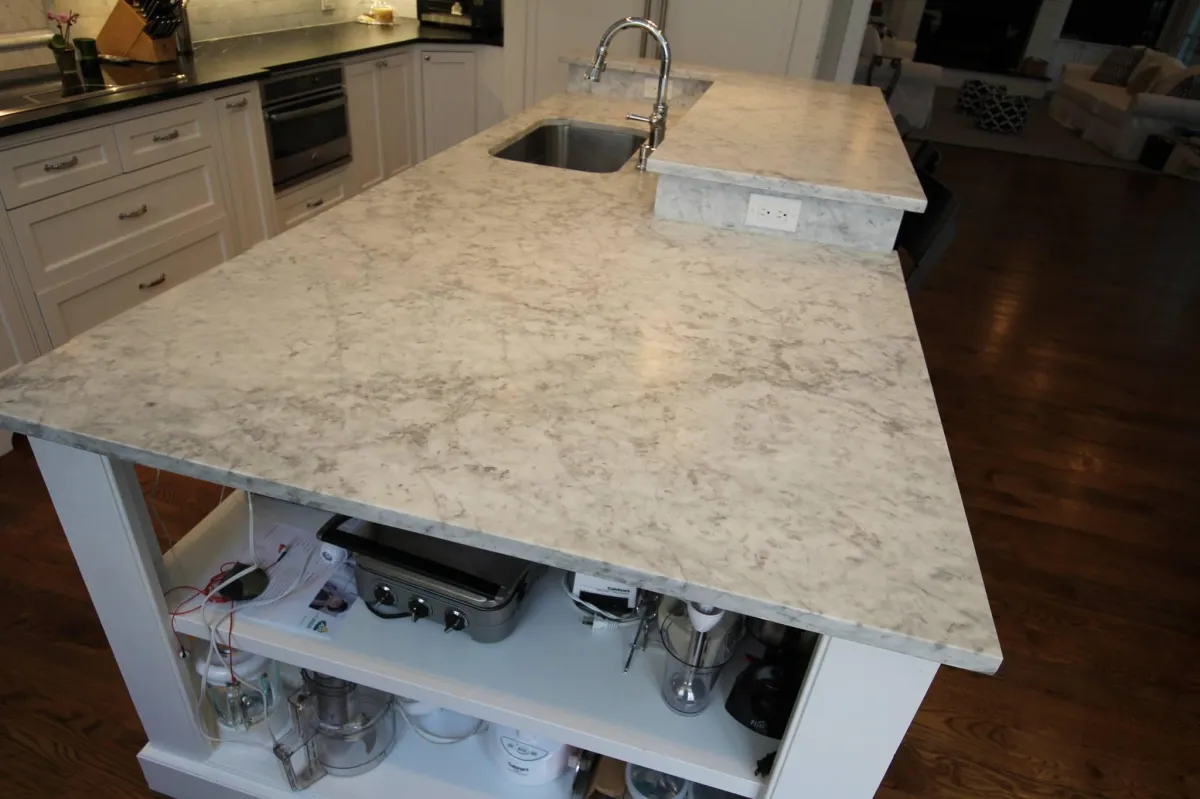
The island is the visual anchor of most Dallas kitchens, and its stone is the natural starting point for building a cohesive multi-surface palette. The island stone establishes the tonal center and visual character of the kitchen. All other stone selections should be evaluated in relationship to it. When the island stone is selected first, it frames the decisions for the perimeter countertop and backsplash clearly. Building the stone palette from the island outward, rather than selecting each surface independently, is the design approach that most consistently produces cohesive results in Dallas luxury kitchens.
Coordinating Stone Across Connected Spaces
In open-concept Dallas homes, the kitchen stone palette is visible from and read in relationship to adjacent spaces. The stone countertops, island, and backsplash are evaluated not just within the kitchen zone but in relationship to the flooring, living room materials, and any stone used in adjacent spaces such as the dining room, bar area, or fireplace surround. If the living room fireplace features a quartzite surround, the kitchen island stone should share tonal alignment with it. Dallas Granite Installers coordinates multi-surface, multi-room stone projects throughout the Dallas-Fort Worth metro area, sourcing complementary materials and managing the design relationships between surfaces across the full scope of a project.
What Disrupts Stone Cohesion
Understanding what creates cohesion also requires understanding what disrupts it. The most common sources of visual fragmentation in multi-stone Dallas kitchens include undertone conflict between surfaces, scale mismatch between the veining movement of different stones, finish inconsistency without design rationale, too many stone materials competing for visual prominence simultaneously, and a backsplash stone or tile that introduces a tonal direction unrelated to either the countertop or the cabinetry palette.
Undertone conflict between surfaces where one carries warm undertones and another carries cool undertones without deliberate design intention
Scale mismatch between the veining movement of different stones in the same kitchen
Finish inconsistency without a clear compositional logic
Too many stone materials competing for visual prominence simultaneously
A backsplash that introduces a tonal direction unrelated to the countertop or cabinetry palette
Seeing the Full Palette Before Committing
No stone selection process for a multi-surface kitchen is complete until all proposed materials are viewed together in the actual space simultaneously. Individual materials that each appear attractive in isolation can produce an unexpected result when combined. Gathering large samples of all proposed stones and laying them together in the kitchen space under both natural and artificial lighting reveals tonal and textural relationships that are impossible to predict from individual showroom evaluations.
The Value of Professional Coordination
Creating cohesion across multiple stone surfaces is a discipline that benefits from professional guidance. Dallas Granite Installers works with homeowners and designers throughout the Dallas-Fort Worth metro area on multi-surface stone coordination from initial palette development through fabrication and installation. Our team is available at (214) 624-0111. Learn more about our countertop installation process, explore design references on stone palette coordination at Architectural Digest, review stone performance and compatibility data at the Natural Stone Institute, and view coordinated stone collections at Cambria.