Understanding Lighting's Impact on Granite & Quartz Countertops | Dallas Granite Installers
Light Is the Variable Most Homeowners Overlook
Stone countertop selection typically happens in a showroom or slab yard under controlled or inconsistent lighting conditions. The slab is evaluated, approved, and ordered. When it arrives in the home, under a completely different set of natural and artificial light conditions, it often reads differently than anticipated. The stone has not changed. The light has.
Light is the single most influential variable in how any stone countertop is perceived in daily use. It determines how a stone's color registers, how its veining reads, how its surface texture is revealed, and how it integrates with the surrounding kitchen elements. Understanding the relationship between light and stone before making a selection is one of the most practical steps a Dallas homeowner can take toward a result that performs as expected in the actual kitchen environment.
Color Temperature and Stone Perception
Artificial lighting is measured in color temperature, expressed in degrees Kelvin. Warm light, which falls in the range of 2,700 to 3,000 Kelvin, emits a yellow-amber quality similar to incandescent bulbs. Cool light or daylight-balanced light, which falls in the range of 4,000 to 6,500 Kelvin, emits a white-to-blue quality that renders colors more neutrally and with greater clarity.
Warm light at 2,700 to 3,000 Kelvin enhances the warm undertones of stone. Cream, beige, gold, and brown tones in granite and quartzite become richer, deeper, and more luminous under warm light. The same effect can make cool-undertone stones appear slightly yellow or ivory in ways that may not be desirable. Cool or daylight-balanced light at 4,000 Kelvin renders stone colors more accurately and more neutrally. White stones appear crisper, gray stones appear cleaner, and veining contrast is typically sharper under cooler light. In Dallas kitchens with significant natural daylight from south or west-facing windows, the effective color temperature of the space shifts toward cooler, brighter conditions during peak afternoon hours.
How Natural Light in Dallas Kitchens Affects Stone
The orientation and window exposure of a kitchen is one of the most important but least considered factors in stone selection. Dallas homes with south and west-facing kitchen windows receive intense direct sunlight, particularly during the afternoon hours between 1:00 PM and 5:00 PM. In these conditions, the kitchen is flooded with high-intensity daylight that creates strong shadows, intensifies veining contrast, and shifts the perceived color temperature of the entire space toward the cooler, more neutral end of the spectrum.
Kitchens with north-facing windows receive diffuse, cool, even light that rarely includes direct sun. This type of light consistently tends to flatten the visual depth of stone and reduce the perceived richness of warm-undertone materials. In north-facing Dallas kitchens, warm-undertone stones with gold and cream tones often perform better than cool, stark-white alternatives, because the warmth of the stone compensates for the cool quality of the ambient light.
Under-Cabinet Lighting and Stone Texture
Under-cabinet lighting is one of the most underutilized tools in kitchen design for enhancing the visual quality of stone countertops. When positioned correctly, under-cabinet LEDs cast directional light across the countertop surface at a low angle, which rakes across the stone's texture and reveals dimensional qualities that overhead lighting cannot produce.
For honed and leathered stone surfaces, under-cabinet lighting creates a subtle but significant visual enhancement. The natural texture of a leathered granite or quartzite surface, which appears relatively flat under overhead light, develops a richly tactile quality under raking under-cabinet illumination. For polished stone surfaces, under-cabinet lighting produces a reflective quality that creates a secondary ambient light source at countertop level, adding a luminous dimension to the stone that overhead lighting alone does not achieve.
Pendant Lighting Over Kitchen Islands
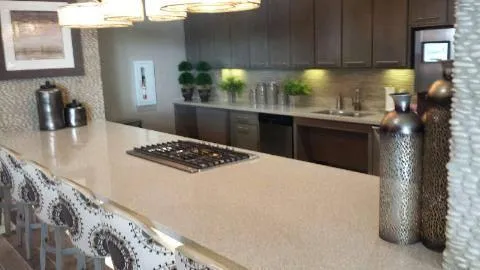
Pendant lights installed over kitchen islands are both a functional and a design element, and their positioning and color temperature directly affect how the island's stone countertop reads in daily use. Pendants that hang 28 to 34 inches above the countertop surface create a focused pool of light on the stone that draws attention to it from across the kitchen and highlights its material character at close range.
The color temperature of the pendant light should be selected in coordination with the stone. For warm-toned stones such as Venetian Gold granite or cream-based quartzites, warm white LED pendants at 2,700 to 3,000 Kelvin enhance the natural richness of the material. For cool-toned stones such as white or gray granites and Calacatta quartzites, neutral white LEDs at 3,500 to 4,000 Kelvin preserve the crispness of the stone. For book matched island countertops, pendant placement should ensure that the light source illuminates the full width of the book matched surface to reveal the veining composition from the living areas of an open-concept Dallas home. Explore our countertop installation services to see how material and lighting coordination is handled across each project.
Recessed Lighting and Stone Accuracy
Recessed down lights are the most common primary light source in Dallas kitchen ceilings, and they are the fixture type that most accurately renders stone color under artificial conditions. The overhead, relatively even illumination of a well-planned recessed lighting layout presents stone countertops with the least directional bias, which means the color and veining read closest to how they appeared under neutral showroom conditions.
Most lighting designers working in Dallas luxury homes specify 2,700 to 3,000 Kelvin recessed fixtures for primary kitchen illumination and supplement with 4,000 Kelvin under-cabinet LEDs for task accuracy at the countertop surface. This combination delivers a warm, residential atmosphere in the general space while maintaining color accuracy at the working countertop zone.
Evaluating Stone Samples Under Your Actual Kitchen Lighting
The practical implication of everything discussed above is that stone selection should never be finalized based on showroom evaluation alone. The showroom is useful for understanding a stone's material character but is not a reliable predictor of how the stone will read under the specific lighting conditions of a specific Dallas kitchen.
Obtain a large sample, at minimum 12 by 12 inches, of the stone under consideration
Place the sample on the countertop surface at the same time of day when the kitchen receives its most intense natural light
Evaluate the sample under the primary artificial lighting of the kitchen with all fixtures illuminated
Turn on under-cabinet lighting if present and observe how the sample responds
View the sample from the primary sight line of the space, including from the living area in open-concept kitchens
Repeat the evaluation in the evening under artificial lighting only to confirm the stone reads as intended under both conditions
Working with a Stone Specialist on Lighting Coordination
Dallas Granite Installers works with homeowners and designers across the Dallas-Fort Worth metro area to coordinate stone selection with the specific lighting conditions of each kitchen. Understanding the orientation of a home, the primary lighting fixtures in use, and the design intent of the space allows for material recommendations that perform as expected once installed. Contact Dallas Granite Installers at (214) 624-0111 to discuss your stone selection in the context of your kitchen's specific lighting environment.
Light Changes Everything. Stone Selection Should Account for It.
A countertop that performs beautifully under the specific conditions of a Dallas kitchen is the product of selection decisions that account for the actual light in the actual space. The stone, the finish, and the artificial lighting all work together as a system. Selecting stone without understanding how light in the home will render it introduces unnecessary risk into a significant investment. For luxury kitchen design guidance that addresses material and lighting together, explore resources at Architectural Digest and consult the Natural Stone Institute for stone-specific performance data. Browse stone fabrication services and explore available premium granite collections for your project.