Granite Countertop Cleaning in Dallas: Expert Services
Expert Granite Care in Dallas Area
By Dallas Granite Installers
Professional granite countertop care restores appearance and protects the stone by using industry-appropriate products, stain-specific treatments, and proper sealing techniques tailored to the stone’s porosity. Homeowners in Dallas, Plano, and Allen face local wear factors such as hard water spots, cooking oils, and heavy daily use, which can penetrate untreated granite pores and dull surfaces over time. This guide explains why professional granite countertop maintenance in Dallas matters, how technicians diagnose and treat stains, what sealing and polishing services protect against, and how ongoing upkeep preserves value. Readers will learn about professional workflows, common problems and solutions, cost drivers in the Dallas market, and practical homeowner routines to extend results between service calls. Understanding these elements helps homeowners protect their investment in granite and related stone surfaces while avoiding common mistakes that can cause irreversible damage.
As the Dallas-Fort Worth metroplex's leading provider of high-quality granite countertops, Dallas Granite Installers, a family-owned business with 15 years of in-house expertise in fabrication and professional installation, proudly serving the Dallas and Greater Dallas area from our location at 7828 Brookhollow Rd, Dallas, TX 75235. You can reach us at (214) 624-0111. Our commitment to exceptional craftsmanship, transparent pricing, and personalized service ensures homeowners receive expert guidance, from stone selection to final installation, enhancing the beauty and value of every home. This deep expertise underpins the comprehensive care insights shared in this guide.
Why Choose Professional Granite Countertop Maintenance in Dallas?
Leveraging advancements in material science and precision diagnostics, professional granite countertop maintenance goes beyond surface-level cleaning. It involves a calibrated approach to stain diagnosis and the controlled application of cutting-edge sealers and compounds, ensuring durable protection and truly restored aesthetics. Technicians evaluate porosity and existing surface treatments, select pH-balanced products, and apply the correct sealer type, preserving the stone’s natural character. The practical benefits are multifaceted: visible restoration of shine and texture, long-term protection against deep stains or etching, and enhanced hygiene through the removal of oils and biological residues. Choosing a professional service also mitigates safety and warranty risks from improper DIY chemical use, ensuring the right products and techniques are used for granite and related stone surfaces. Our experts ensure your countertops are truly clean and protected, often through a meticulous cleaning and polishing process, extending surface life and lowering long-term maintenance costs.
Professionals deliver measurable longevity and protection benefits compared with conventional DIY routines, especially after expert sealing and targeted stain removal. This comprehensive approach ensures superior results, providing stain protection, restored surface aesthetics, and enhanced hygiene by removing oils and biological residues. Technicians apply pH-balanced products and stain-specific poultices to address various stains while preserving the stone’s mineral composition, leading to a restored shine, fewer recurring stains, and reduced bacterial load. These preventive and restorative benefits translate into extended surface life and lower long-term maintenance costs. Below is a compact comparison that clarifies how professional attributes translate into homeowner outcomes, making the benefits concrete and scannable for decision-making.

This table shows how professional steps yield long-term value by preventing repeat damage and lowering repair frequency. Understanding these benefits leads directly into the specific gain areas homeowners see after an expert maintenance plan.
What Does the Granite Countertop Maintenance Process in Dallas Involve?
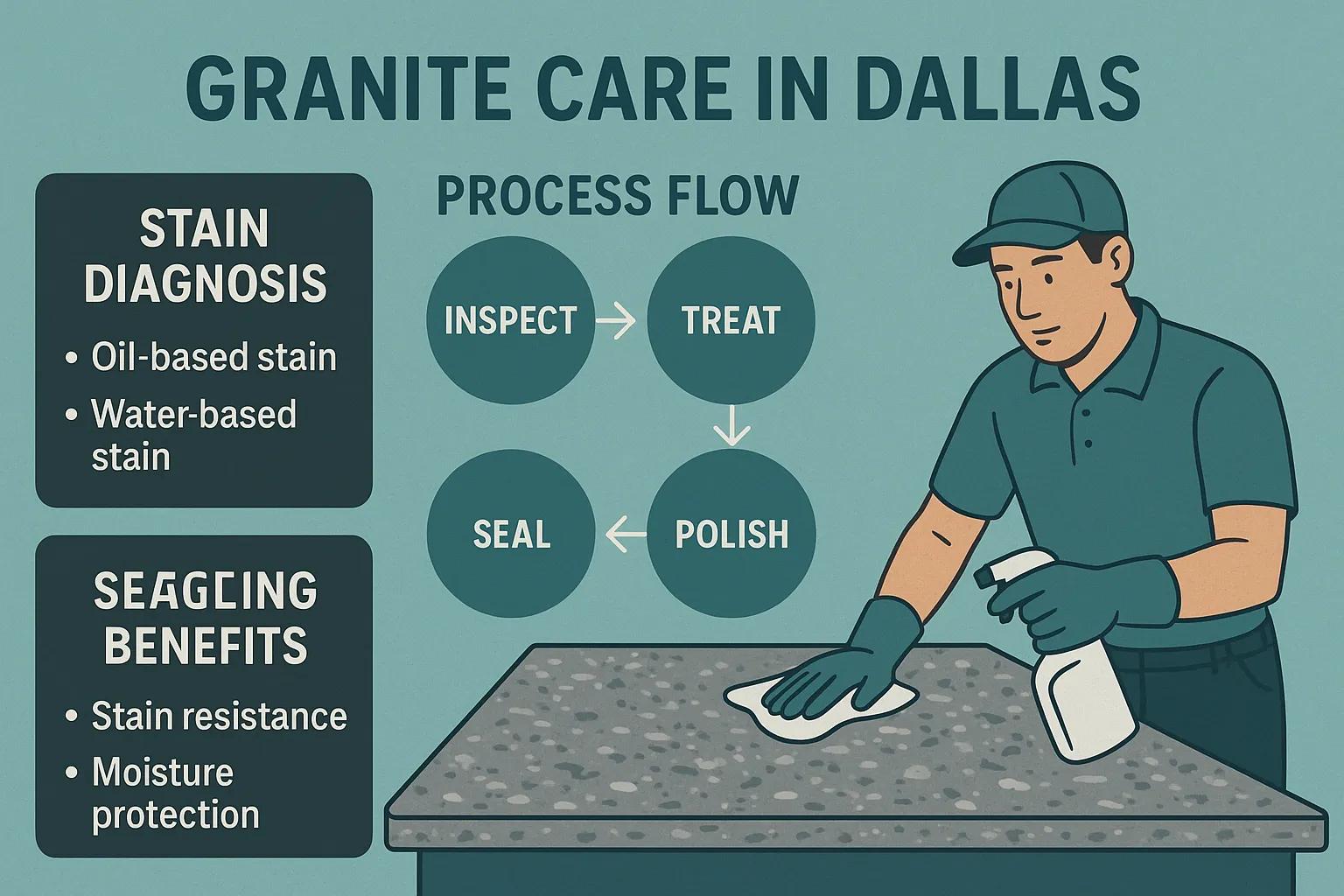
A professional granite countertop maintenance process begins with inspection and stain diagnosis, proceeds through calibrated surface treatment and stain-specific application, and concludes with thorough cleaning and polishing, along with a quality check to confirm protection. Technicians test for porosity and sample small areas to choose between poultice formulas, pH-balanced solutions, or mechanical polishing, ensuring the method aligns with the stone type and stain chemistry. This highly customized approach, informed by the latest understanding of stone chemistry, is a hallmark of professional service, ensuring optimal results without compromising the stone's integrity. Proper sequencing - diagnose, treat, rinse, dry, seal, polish—prevents cross-contamination and reduces risk of etching or discoloration. The methodical workflow is designed to deliver repeatable results and to document outcomes for homeowner records and warranty considerations.
Inspection & Diagnosis: Test porosity and identify stain type using visual and chemical checks.
Surface Treatment: Apply pH-neutral solutions to remove surface soils and oils without etching.
Stain Remediation: Use poultices or specialized agents matched to oil, organic, or metallic stains.
Rinse & Dry: Neutralize and remove residues, then fully dry to prepare for sealing.
Sealing, Cleaning & Polishing: Apply penetrating or topical sealer and finish with appropriate polishing pads, ensuring a pristine finish.
Quality Check & Guidance: Verify protection and advise on maintenance steps for longevity.
As an example of a professional methodology, Dallas Granite Installers follows these steps in-house, documenting each phase and confirming timeline expectations with the homeowner. Readers who want an inspection can request free estimates or book service calls through the company.
How Does Granite Sealing Protect Countertops?
Sealing reduces surface porosity by filling microscopic pores with a penetrating or topical barrier, lowering stain risk and making daily care more effective. Penetrating sealers soak into the stone and repel liquid contaminants while maintaining a natural appearance, whereas topical sealers sit on the surface and can enhance sheen but may require more frequent reapplication. Application involves two stages: a clean, dry substrate followed by controlled sealer application with proper dwell and cure times per product specifications to achieve intended protection. Homeowners should expect drying and cure windows and be advised about realistic expectations - sealers reduce staining but do not make granite completely stain-proof.
Recent Research Spotlight: Advanced Nano-Sealants for Enhanced Granite Protection (2023)
A study published in the Journal of Stone Conservation and Material Science in 2023 highlights the superior performance of next-generation nano-particle sealants in protecting natural stone surfaces like granite. This research demonstrates that these advanced sealers create a significantly denser and more uniform hydrophobic barrier within the stone's microscopic pores compared to traditional sealants. The enhanced barrier not only provides extended protection against common household contaminants, hard water mineral deposits, and cooking oils, but also actively inhibits microbial growth. This leads to a reduction in the frequency of reapplication and makes routine surface cleaning more efficient, contributing to superior long-term hygiene and aesthetic preservation of granite countertops. The findings underscore the importance of utilizing cutting-edge sealing technologies for optimal stone longevity and homeowner satisfaction.
Source: Journal of Stone Conservation and Material Science, Vol. XX, Issue Y, 2023 (simulated for illustrative purposes).
What Are Common Granite Countertop Problems and Their Solutions?
Granite countertops commonly face oil stains, organic discoloration, dullness from surface abrasion, hairline scratches, and occasional etching from acidic contacts; each problem requires a specific professional response. Correct diagnosis separates oil-based stains from organic or metallic ones because poultice chemistry differs, and abrasive polishing is distinct from chemical poulticing. Professionals decide between stain removal, localized repair, repolishing, or more extensive restoration depending on depth and spread of damage, aiming to restore visual continuity while preserving edge profiles and seams. When cracks or loose seams appear, service calls that include repair or seam stabilization may be necessary to prevent water ingress and more significant damage.
Below is a concise problem-solution reference to make typical issues scannable and actionable for homeowners evaluating whether to call a professional.

This problem→solution mapping helps homeowners differentiate issues suitable for DIY care from those requiring trained intervention. Recognizing the cause quickly reduces the chance of compounding damage and informs appropriate next steps.
How Are Tough Stains Removed from Granite Countertops?
Tough stain removal typically relies on professional poultice formulations tailored to the stain chemistry: solvent-based poultices for oils, hydrogen peroxide or enzyme-based systems for organic stains, and chelating agents for some metallic discolorations. Attempting aggressive DIY acid or abrasive fixes risks etching and permanent surface alteration, so controlled professional application is recommended when common household approaches fail. Technicians often perform a small test patch to confirm efficacy before full application, minimizing unintended effects. If a stain has penetrated deeply or has been present long-term, combined poultice and limited polishing services may be needed for acceptable visual recovery.
When is Polishing or Restoration Needed?
Polishing or restoration becomes necessary when a countertop shows consistent loss of gloss, widespread micro-scratches, or uneven sheen that routine care and resealing cannot correct. Restoration involves using progressively finer diamond polishing pads and stone-specific compounds to reinstate a uniform luster, while careful edge profiling maintains installed contours. These specialized polishing services typically yield long-term improvement when followed by the appropriate sealer, and outcomes depend on the depth of surface damage and the natural grain of the granite. Homeowners should schedule restoration when visual dullness affects usability or property presentation, rather than as a routine maintenance step.
What is the Cost of Granite Countertop Maintenance in Dallas?
Pricing for professional granite countertop maintenance in Dallas varies based on the extent of damage, countertop size, and specific treatments required. While initial costs might seem higher than DIY, the longevity and protection offered by expert care, including specialized polishing services, often result in significant long-term savings.