Designing Statement Fireplaces with Natural Stone in Dallas | Dallas Granite Installers
The Fireplace as an Architectural Anchor
In Dallas luxury homes, the fireplace occupies a unique position in the spatial hierarchy of a living space. It is not merely a functional element. It is the architectural anchor of the room, the surface the eye moves toward first and returns to repeatedly. How that surface is finished determines whether the fireplace reads as a quiet background detail or as the defining feature of the entire interior.
Natural stone is the material most capable of delivering the visual weight and permanence that a statement fireplace requires. Its thermal properties make it an appropriate choice for the physical demands of a fireside application, and its material character, the depth, variation, and tactile quality that no manufactured surface replicates, gives a stone fireplace surround a presence that endures and improves with time. In the Dallas market, where open-concept living spaces and high ceilings are standard in luxury construction, a stone fireplace surround scaled to the architecture of the room becomes the single most powerful design statement in the home.
Stone Types That Work for Fireplace Applications
Not every stone is equally suited to fireplace design. The selection must account for both thermal exposure and the visual demands of the specific application. Fireplaces vary significantly in how much direct heat the stone actually receives, depending on whether the installation uses a traditional open-hearth design, a gas insert, or a sealed glass-front firebox.
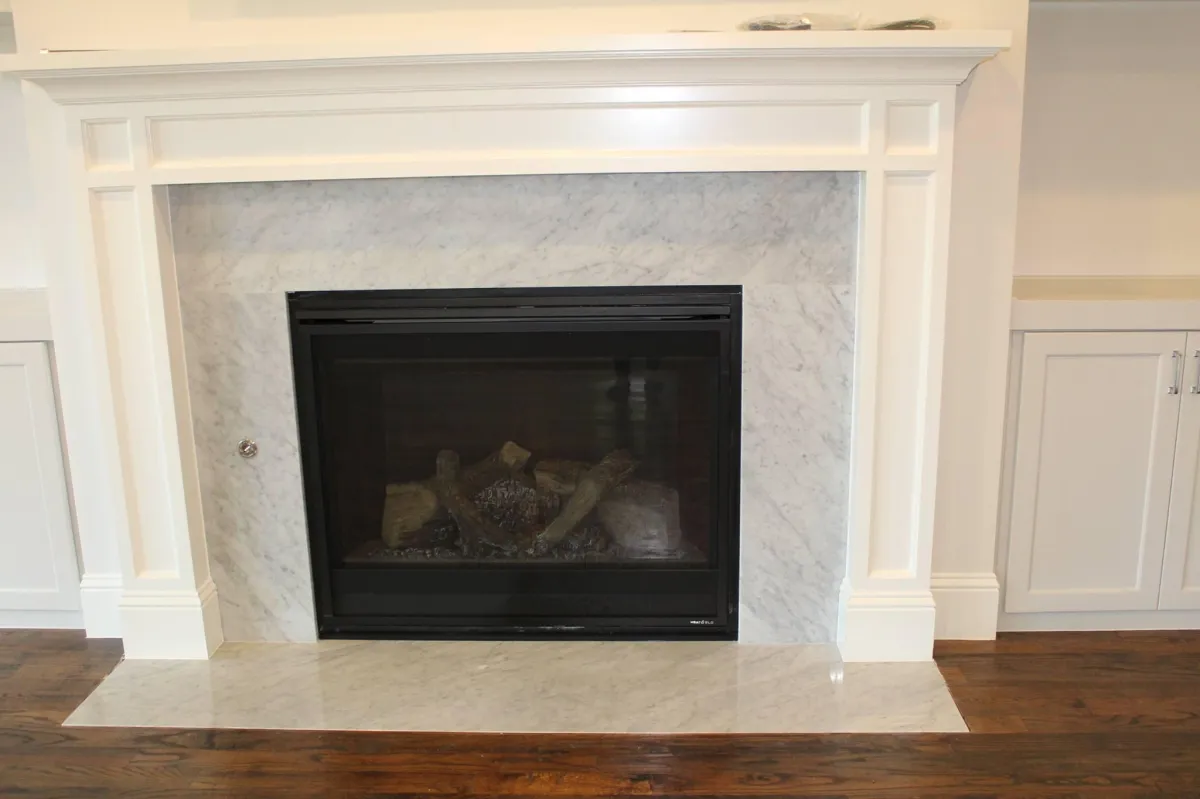
Granite is among the most thermally resilient natural stones available for fireplace applications. With a Mohs hardness rating between 6 and 7 and a mineral composition that includes quartz, feldspar, and mica, granite handles radiant heat and incidental contact with significant temperature differentials without cracking, discoloring, or delaminating. Quartzite, with a Mohs hardness rating above 7, offers comparable thermal resilience with the added advantage of dramatic natural veining that creates a more elevated visual character. Marble brings a level of visual refinement suited to formal living spaces, though its softer composition means it performs best on legs and headers positioned at a safe distance from the firebox opening. Soapstone has a centuries-long history in traditional fireplace construction because of its exceptional heat retention and natural non-porosity.
Stone Fireplace Design Approaches for Dallas Homes
The design approach for a stone fireplace should be chosen based on the architectural scale of the room, the ceiling height, and the interior style of the home. Dallas luxury construction frequently features ceiling heights of 11 to 14 feet in living areas, which means a fireplace surround scaled conservatively will read as undersized against the spatial context.
Floor-to-ceiling stone feature wall: Stone covers the full wall face from floor to ceiling, with the fireplace integrated as a functional element within the stone mass
Full stone surround with floating mantel: Stone surrounds the firebox on all sides, from the hearth extension through the legs and header, with a stone or complementary wood mantel shelf positioned above
Recessed linear fireplace with bookmatched stone panel: A horizontal linear gas fireplace is recessed into a wall finished with a single bookmatched stone panel
Hearth extension only: Stone is applied to the hearth floor projection and immediate surround, with the wall treatment in a contrasting or complementary material
Scaling the Surround to Dallas Architecture
Scale is the most frequently mishandled aspect of stone fireplace design in residential applications. A surround that is appropriately proportioned for an 8-foot ceiling reads as undersized in a 12-foot room. The visual mass of the stone installation should be calibrated to the height and width of the wall on which it sits.
The general principle for high-ceiling Dallas living rooms is to extend the stone vertically to a height that represents at least 60 percent of the wall height. For a 12-foot wall, a stone surround that terminates at 7 to 8 feet reads as complete and architecturally integrated. Width should also be considered in relation to the firebox opening. The stone legs flanking the firebox should be at least 8 to 10 inches wide to carry adequate visual weight, with wider legs of 12 to 18 inches for large rooms.
Fireplace Design Approach by Stone and Context
Design ApproachStone Best SuitedVisual ImpactBest ForFloor-to-ceiling feature wallCalacatta quartzite, bold-veined marbleOutstandingOpen-concept luxury living roomsFull surround with mantelGranite, marble, quartziteHighTransitional and traditional Dallas homesLinear recessed with stone panelBookmatched quartzite or marbleOutstandingContemporary minimalist interiorsHearth extension and surroundGranite, soapstone, slateModerate to HighSecondary rooms and kitchensFloating stone shelf onlyAny stone with edge detailModerateAccent applications in smaller spaces
Hearth Stone Selection and Sizing
The hearth, the stone floor extension projecting in front of the firebox opening, is subject to the most direct thermal and physical stress in any fireplace installation. It receives falling embers, radiant heat, and the weight of hearth tools and log storage. Granite and soapstone are the most consistently specified materials for hearth applications. Granite's density and hardness make it resistant to impact, staining, and heat damage. Soapstone's natural non-porosity means it requires no sealing and is impervious to ash and soot penetration.
Hearth sizing in the Dallas area typically requires a minimum projection of 16 to 20 inches in front of the firebox opening. For design purposes, a hearth that extends 20 to 24 inches in front of the opening and spans the full width of the surround plus 6 inches on each side creates a proportionally balanced composition.
Integrating the Fireplace Stone with Kitchen and Adjacent Surfaces
In open-concept Dallas homes where the fireplace wall is directly visible from the kitchen, the relationship between the fireplace stone and the kitchen countertop stone is a design consideration that rewards deliberate coordination. Using the same stone in both applications, or selecting stones from the same tonal family with complementary movement, creates an interior that reads as architecturally coherent rather than assembled from unrelated choices.
Dallas Granite Installers regularly coordinates stone selection across kitchen and fireplace applications within the same project, sourcing matched or complementary slabs to ensure tonal and textural consistency throughout open-plan spaces. This coordination is most effective when the stone for both applications is selected from the same slab inventory at the time the project is specified. View our full range of stone fabrication services for multi-surface project coordination.
Finish Options for Stone Fireplace Surrounds
The finish applied to a fireplace stone affects both its visual character and its practical performance in a heat-adjacent environment. Polished finishes reflect light and intensify the visual depth of the stone, which creates a highly formal, refined appearance suited to traditional and transitional design contexts. Honed finishes produce a smooth, matte surface that reads with quiet sophistication appropriate for contemporary and minimalist Dallas interiors. Leathered finishes add a tactile dimension that suits both traditional and contemporary applications and conceal surface marks exceptionally well, making them a practical choice for a fireplace surround that is frequently touched and admired at close range.
Fireplace Stone Installation Requirements
Stone fireplace installation requires professional fabrication and setting that accounts for thermal expansion, substrate preparation, and the structural requirements of the specific application. Large stone panels used for floor-to-ceiling feature walls require secure mechanical anchoring to wall studs, not adhesive alone. Hearth stone must be set on a substrate capable of bearing the weight of dense natural stone at a location subject to thermal cycling.
The Natural Stone Institute provides installation standards for stone fireplace applications that professional fabricators and installers are expected to follow. Dallas Granite Installers applies these standards on every fireplace project across the Dallas-Fort Worth metro area. Call (214) 624-0111 to discuss your fireplace design. For design inspiration from luxury interiors, explore fireplace concepts at Architectural Digest.
Where to Begin the Design Process
A stone fireplace project begins with the selection of the stone and the design of the surround, not with the installation. The stone choice drives every subsequent decision, from the proportions of the surround to the finish, edge profile, and hearth configuration. Beginning with material selection allows the design to be built around the specific visual character of the stone rather than forcing a generic template onto whatever material happens to be available.
Dallas Granite Installers works with homeowners and interior designers throughout the Dallas-Fort Worth metro area from initial material selection through completed installation. View premium stone collections suited to fireplace applications and explore our countertop installation services. Call (214) 624-0111 to begin your project.